
Understanding Residual Current Types and the Importance of DC Residual Current Protection
DC Residual Current Protection
1. Introduction to Residual Current
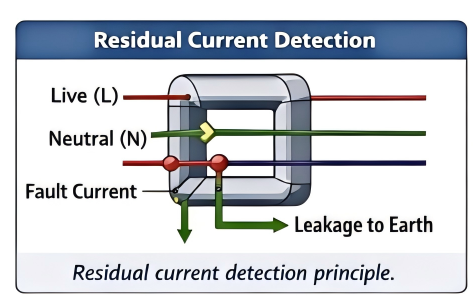
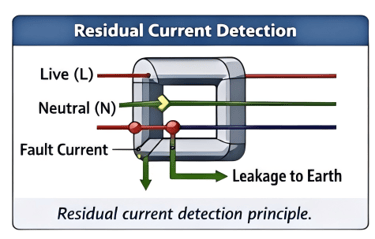
Residual current refers to the imbalance between the currents flowing in the outgoing conductors and the return neutral conductor in an electrical circuit. When these currents do not sum to zero, it indicates that some current is leaking to earth or an unintended path, which poses serious safety hazards such as electric shock or fire. Modern protective devices leverage this principle to rapidly disconnect power under fault conditions.
Image: Illustration of residual current detection with live and neutral conductors passing through a core balance transformer.
2. Classification of Residual Current Devices (RCDs)
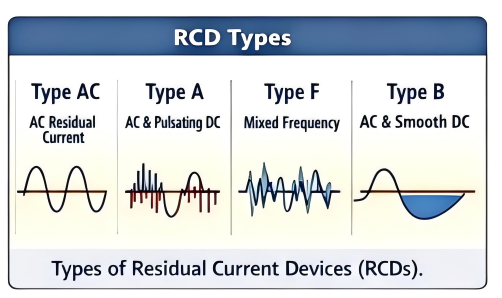
Residual Current Devices (RCDs)—also called Residual Current Circuit Breakers (RCCBs) or Ground Fault Circuit Interrupters (GFCIs)—are classified by their ability to detect different waveforms and current types.
2.1 Type AC
Detects only sinusoidal AC residual currents.
Suitable for purely AC systems without power electronic loads.
2.2 Type A
Detects sinusoidal AC and pulsating DC residual currents.
Intended for circuits with rectifiers or electronic loads (e.g., LED drivers, VFDs).
2.3 Type F
Designed to detect composite residual currents including high-frequency components, common in converters and drives.
Adds compatibility for mixed-frequency leakage currents.
2.4 Type B
Detects smooth DC, pulsating DC, and AC residual currents.
Critical for systems with power electronics, EV chargers, and photovoltaic inverters.
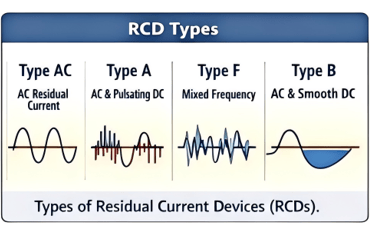
Image: Types of residual current devices(RCDs)
3. Why DC Residual Current Protection Is Important
With the proliferation of power-electronics-based systems, circuits increasingly contain rectifiers and DC components. Traditional RCDs (Type AC) cannot reliably detect smooth DC residual currents, as direct current does not alternate and therefore does not generate the necessary AC imbalance signal for detection.
3.1 Safety in Modern Electrical Systems
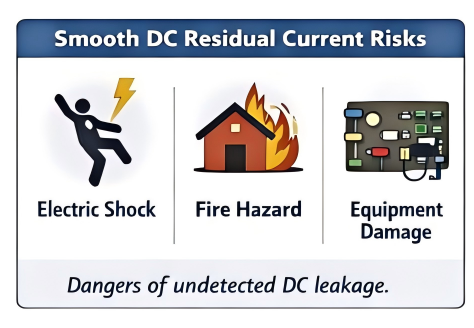
Electric Shock Prevention: DC residual currents flowing through a person or conductive path can still cause severe injury or fatality. Detecting these currents prevents prolonged fault exposure.
Fire Hazard Mitigation: Leakage currents can heat insulation and conductive paths over time, leading to insulation breakdown and fire risk.
Equipment Protection: Sensitive equipment (charging systems, power converters) can be damaged by undetected leakage, leading to reliability issues.
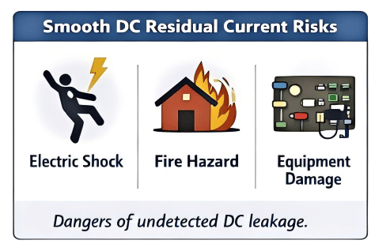
Image: Dangers of undetected DC leakage
3.2 Critical in EV Charging and Solar PV Systems
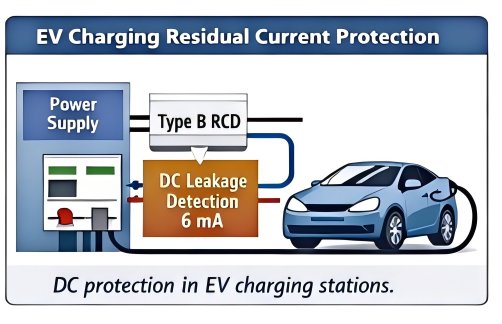
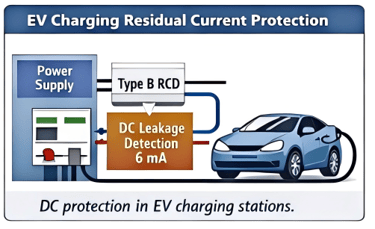
Modern electric vehicle (EV) charging stations and photovoltaic (PV) systems inherently involve DC components. For example, EV charging infrastructures may produce smooth DC leakage between the vehicle battery and the grid. Standards such as IEC 62955 require residual current detecting devices capable of identifying DC leakage currents at low thresholds (e.g., 6 mA) to ensure safety compliance.
Image: Block diagram of residual current protection in EV charging architecture.
4. DC Residual Current Protection Technologies
4.1 Type B RCDs
Type B RCDs are specifically designed for full-spectrum detection:
✔ AC sinusoidal
✔ Pulsating DC
✔ Smooth DC
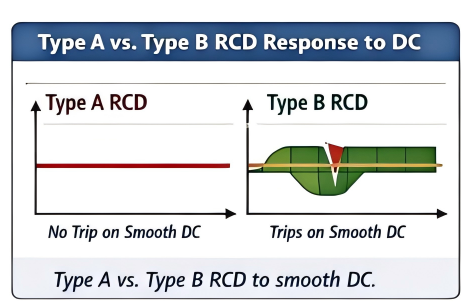
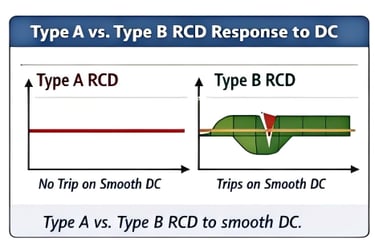
Notably, they are indispensable in applications with DC present because they prevent residual current blinding—a state where DC current saturates the detection core and inhibits operation.
Image: Comparison graphic showing Type A vs. Type B RCD response to smooth DC.
4.2 DC RCD (DC Residual Current Devices)
Newer standards have introduced DC-specific RCD protections adapted for pure DC environments, like DC microgrids and DC fast chargers. These devices ensure protection even in installations without AC components, driven by standards such as IEC 60755-1 and IEC TS 63053.
5. Selection and Implementation Considerations
When choosing residual current protection:
Match the RCD type to the expected waveform composition of the circuit.
In EV charging, combine RCDs (such as Type A with DC 6mA detection or Type B) to meet regulatory safety requirements.
Ensure devices are installed and tested by qualified personnel, and periodically verify trip characteristics and performance.
6. Conclusion
Residual current protection is a cornerstone of electrical safety. Traditional RCDs that only detect AC residuals are no longer sufficient in the age of power electronics, renewable energy, and DC-rich applications such as EVs and PV. Advanced DC-capable RCDs provide essential detection of smooth DC leakage currents, preventing shock, fire, and equipment damage. Selecting the right device type—whether Type A, Type B, or DC-specific RCD—is critical for robust, standards-compliant systems.
Stay Connected


Power You Can Sense
R&D Center: No.399 Duhui Rd, Minghang, Shanghai
Operation office: No.199,Tianshu Rd, Nanhu, Jiaxing
Email:sales@evsensepower.com